FINALLY! An Ad Guaranteed Way to Make YOU $$$

Wednesday, July 27, 2016

Melanoma survival double with both immunotherapy AND local peripheral treatments.

Sciencedaily.com today reported a study and clinical trial which showed that metastatic melanoma patients who received BOTH ipilimumab/Yervoy AND local peripheral treatments had more than double the survival period (93 weeks) of those who only received Yerboy (42 weeks).

This is an especially interesting subject to me because I'm a malignant melanoma survivor from a decade ago and I wrote a booklet about how I survived before these treatments were available,
http://www.amazon.com/John-A.-McCormick/e/B00287RNFS

Back a decade ago there were NO chemotherapy treatments for malignant melanoma which did more than make a very marginal improvement in life expectancy.

I found European clinical studies which showed that Vitamin D-3 more than doubled the survival rate.

There is also considerable evidence that the spice turmeric - often found in curry, also improves your chances of survival.

Since neither of these would in any way interfere with more recent treatments I suggest patients read the scientific results I cite in my book and consider adding Vitamin D-3 and or turmeric to their diets.

My book is the lowest price I could set, 99-cents and Amazon Prime members can read it for free.

Saturday, July 23, 2016

Linus Pauling Vindicated on Vitamin C??Cancer Study Says YES!

Since I only post critical news, rather than attempt a story every day, you might want to subscribe for a feed so you don't miss anything that might save your life. The only limit on postings is that they must be critical news with life-saving potential.

Two time Nobel Laureate Linus Pauling was ridiculed for his suggestion that high dose Vitamin C could fight cancers but recent studies show he may have been on track for a third Nobel for his suggestion.

For ovarian cancer there is an open text study published at www.ncbi.nlm.nih.gov
Two key paragraphs are these found near the end.
“For patients, quality of life is a key issue. In a self-assessment administered to 39 terminal cancer patients treated with 10 g of intravenous ascorbate at 3 day intervals combined with daily administration of 4 g orally for 1 week, quality of life was reportedly improved on several scales. Specifically, patients rated physical, emotional, and cognitive function higher and several symptoms, including nausea, vomiting, loss of appetite, and fatigue, lower after ascorbate treatment. Similarly, advanced cancer patients in the phase I trial who received intravenous ascorbate doses >0.4 g/kg sustained quality of life for the duration of the trial.”
However, neither of these trials had a placebo control. How intravenous ascorbate might mediate improved wellbeing is unknown; further examination with appropriate placebo controls may be worthwhile.
In summary, intravenous ascorbate therapy is safe, well tolerated, and has minimal side effects compared to most standard agents, as verified by both case studies and early clinical trials. Additionally, intravenous ascorbate may contribute to maintaining quality of life.
“Current trials are investigating the potential efficacy of pharmacologic ascorbate given over longer durations in combination with standard chemotherapies.”
Very recent studies just published in Science, the journal of the American Association for the Advancement of Science into the use of Vitamin C in treating two kinds of cancer in rats show very promising results and the same cancer types are found in difficult-to-treat human cancers.
Although the actual study is available only to members, the AAAS provides a summary atsciencemag.org
This study found that colon cancer cells often grow because of mutations in the KRAS or BRAF genes. These cells are fed by high levels of glucose (sugar) but the transporter, GLUT1 also carries Vitamin C to cells as the dehydroascorbic acid (DHA) oxidized form.
Bombarding the cells with high doses of the DHA (Vitamin C) can block free radicals and high doses actually do kill those colon cancers in the lab. The dosages required would require patients eating unbelievable amounts of fruits such as oranges but fortunately the same Vitamin C can be purchased in kilogram packages very inexpensively and mixed with sterile water for IV feeds.

Conclusions?

Since Vitamin C is very cheap and people can not only tolerate it in massive dosages but will probably actually improve their quality of life, it appears that human trials could easily be approved and conducted. Because there is no real safety question, some doctors may agree to give their cancer patients the massive doses along with whatever traditional treatment such as chemotherapy which they are already getting.
I wrote this up before beginning this blog at 

Sunday, June 19, 2016

NEW HOPE for Brain Cancer Treatment!

Treating infections or tumors in the human brain is almost always a matter of surgery because of something called the blood-brain barrier (BBB) which is a sort of gatekeeper to the brain.

A new clinical trial of patients with glioblastoma (a kind of brain cancer tumor) shows that bursts of high intensity sound can temporarily disable the BBB allowing chemotherapy drugs to attack the tumor(s).

The function of the BBB is to protect the delicate brain. It consists of three major components.

One, limited spacing between endothelial cells (a thin layer of cells coating the walls of blood vessels) which limits the amount and kind of material which passes through the wall to the cells.
Two, proteins which actually transport the chemicals to the brain are specific to just the kinds of things (such as glucose - blood sugar) and ketones which provide an alternative source of energy. Also passed are fatty acids and some amino acids.

Three, a set of enzymes which attack and alter undesired blood contents.

A clinical trial just published in the Science Translational Magazine (AAAS Science.org) shows that many tumors such as a glioblastoma which is very aggressive, can now be treated using a combination of traditional chemotherapy and sound.

Researchers have found that a pulsed ultrasound device implanted in the skull and activated during treatment sessions can interrupt the effectiveness of the blood-brain barrier, allowing the chemotherapy to cross from the bloodstream to the brain and attack the tumor.

The system called SonoCloud was shown by MRI studies to interrupt the BBB at acoustic pressure levels up to 1.1 megapascals without any adverse effect on the brain tissue in radiologic or clinical tests.

Details aside, the important point for patients and families (as well as the few doctors who I know actually read this blog) is learning that there IS, or soon will be an alternative to brain surgery to treat cancers which could be treated with chemotherapy if they were in a less well protected part of the body.

Wednesday, June 15, 2016

WHO -- Coffee NOT a Cancer Cause!

Although this isn't probably critical news, it is a very important topic for so many people that I felt it fit in this blog.

For decades the World Health Organization and various other medical groups have been back and forth on the question of whether coffee is good for you or bad for you and the WHO actually said 25 years ago that they were concerned that coffee could cause bladder cancer.]

Fortunately for the many of us who feel life without coffee is barely living at all, they have now reversed their earlier position having determined that it isn't coffee which is the cancer threat, but very hot coffee, or any very hot beverage.

So stop burning your mouth with hot drinks and stick to burning your tongue with spices instead and you can enjoy that cup of coffee without guilt!

Coffee does NOT cause cancer.

Saturday, June 4, 2016

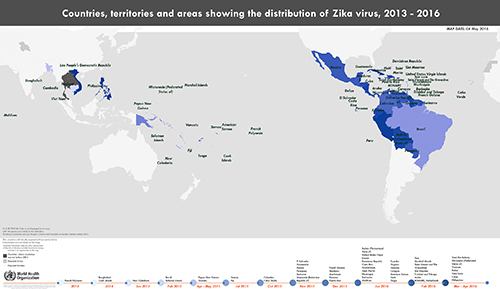
Zika Virus Spreading Like Wildfire

According to the most recent report from the WHO, as of June 1, eleven countries have reported “microcephaly and other central nervous system (CNS) malformations potentially associated with Zika virus infection.”


While no NEW countries have been added to incident lists, 60 countries and territories have already reported continuing mosquito-borne transmission and 46 countries are seeing the first Zika virus outbreak this year.


By comparison, from 2007 through 2014 only fourteen countries had reported evidence of Zika virus transmission.


At this time ten countries have now reported probable sexual transmission of the Zika virus.


Cases in the U.S.A., Slovenia, and Spain report microcephaly in infants which were borne to mothers who had recently visited Brazil.


Among possible cases are two which are still being verified in  Venezuela and Costa Rica.
In addition, 13 countries and territories worldwide report additional incidents of Guillain-Barré syndrome (GBS) above the normal average.


In Guadeloupe a Zika infection was found in a myelitis (a severe neurological condition) patient.


There is now a scientific consensus that a Zika virus infection can cause microcephaly and GBS.

Compare this map from the WHO with the one from February, 2016 below from my earlier Zika report.


Tuesday, May 31, 2016

Drug Resistant E. coli Moves to U.S.

The first reported incidence of a colistin-resistant E. coli. Has been reported in Pennsylvania.

The U.S. military science blog has reported that the Multidrug-resistant Organism Repository and Surveillance Network (MRSN) at the Walter Reed Institute of Research had identified the first colistin-resistant mcr-1 E. coli in a person in the United States. A USDA and HHS search for colistin-resistant bacteria in food animals, retail meats and people also has found colistin-resistant E. coli in a single sample from a pig intestine.

Other reports are that this occurred in a middle-aged woman in Pennsylvania and that although the particular strain was treatable with other antibiotics this is a critical final stage in the development of a true superbug which is resistant to all antibiotics.

The reason is that this particular strain of the common Gram-negative E. coli bacteria carries the mcr-1 resistance gene which is a free floating strand of DNA meaning it can easily be shared with and transferred to other strains, many of which may be resistant to every other antibiotic except for the 50-year old colistin drug which was almost completely discontinued in the 70’s due to its human toxicity.

Once that colistin resistance gene moves to another Gram-negative bacteria strain which is already resistant to everything else we will have a common infectious agent for which there is no treatment.

Last year President Obama released a National Action Plan for Combating Antibiotic Resistant Bacteria charging the military to treat drug resistant infections as a top priority and a major threat.

According to the NIH,“The problem with re-introducing an older drug, such as colistin, though, is that techniques for evaluating new drugs have evolved since the 1950s, and therefore, little is known about the dose needed to effectively fight infection while limiting the potential emergence of antimicrobial resistance and reducing potentially toxic side effects. More data are needed to guide optimal use of these older medications.”

For detailed information see American Society for Microbiology, “Escherichia coli Harboring mcr-1 and blaCTX-M on a Novel IncF Plasmid: First report of 2 mcr-1 in the USA”

New Test Helps Predict if Relative will Awake from Vegetative State.

One of the biggest challenges facing doctors and patient relatives in hospitals is when or if you should remove life support from a comatose patient.

It turns out that an already common tool, positron emission tomography or a PET scan can be interpreted to determine which unconsious patients are actually brain dead (vegetative state) or merely unconscious but with minimal brain activity as shown by the traditional measure, an EKG.

“This is really cool what these guys did here,” says neuroscientist Nicholas Schiff at Cornell University, who was not involved in the study. “We’re going to make great use of it.” http://www.sciencemag.org/news/2016/05/will-you-wake-vegetative-state-new-test-could-tell

A PET scan actually generates antimatter (technically known as radionuclides in medical applications) in incredibly tiny quantities which can be used as a tracer.

The positrons (positively charged antimatter equivalent of electrons) decay over a short period of time releasing gamma rays which are easily detectable.

A common PET scan tool which uses a fluorodeoxyglucose (FDG) tracer shows changes in the glucose (sugar used by the body’s cells and an indication of activity due to energy consumption) levels of the brain.

Unlike many clinical tools a PET scan is relatively simple and easy to conduct but previously they were used to detect disease - the new results show they can also indicate very low levels of brain activity.


An incredibly new tool helping both doctors and families determine which patients have any potential for eventually waking up.